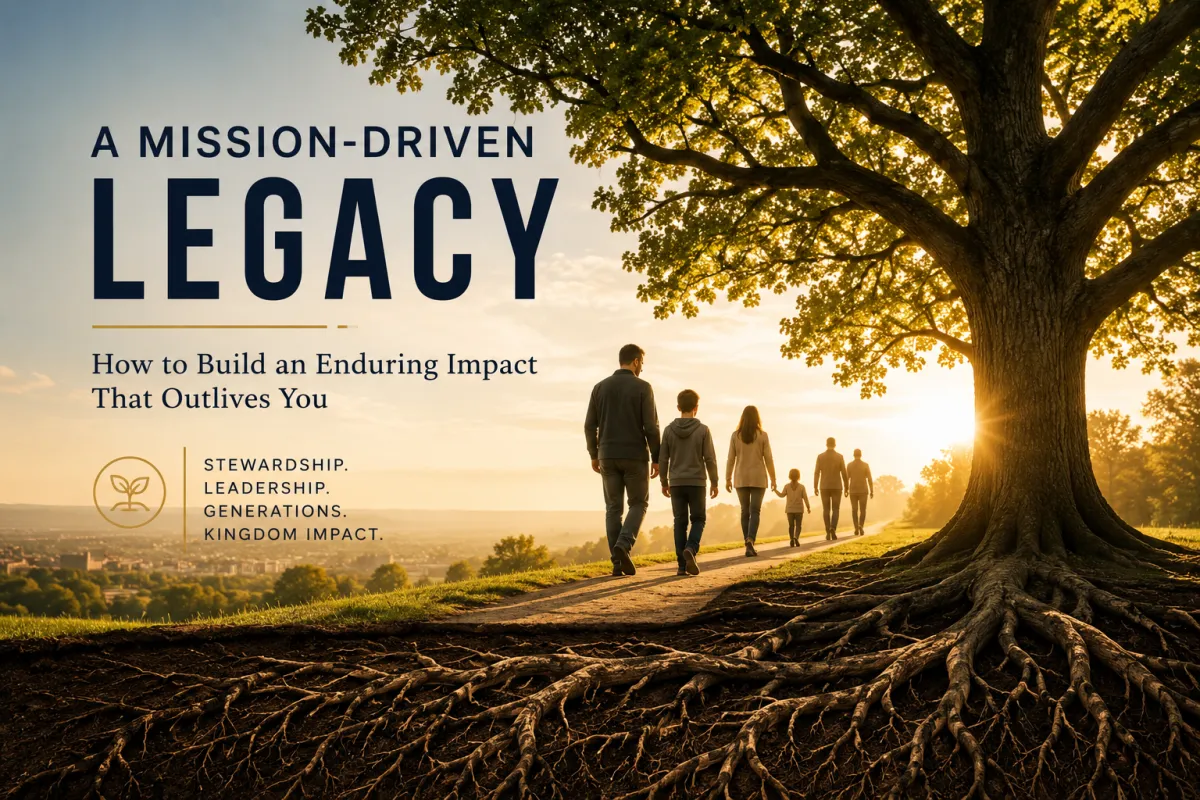
A Mission-Driven Legacy: How to Build an Enduring Impact That Outlives You
A Mission-Driven Legacy: How to Build an Enduring Impact That Outlives You
Will what you've built continue when you're gone?
Every mission-driven leader must consider this question. Legacy is not defined by personal influence or indispensability, but by whether the mission thrives after leadership transitions. Many organizations succeed under strong leaders but falter after their departure. Enduring organizations are intentionally structured to outlast any individual. Exceptional leaders focus on developing people, fostering healthy cultures, and building organizations that advance the mission for generations.
The Difference Between Success and Legacy
Growth metrics like revenue, ROI, and expansion are important, but they do not tell the whole story. A lasting legacy is measured by an organization’s ability to develop future leaders, maintain a healthy culture, remain true to its mission, and uphold its core values through leadership transitions. Organizations reliant on a single individual may appear successful yet remain vulnerable. Enduring organizations are built around a mission that outlasts any leader.
Stewardship Means Thinking Beyond Yourself
Scripture teaches that leadership is an act of stewardship, not ownership. Psalm 24 reminds us that everything we have—including organizations, influence, resources, and opportunities—belongs to God and is entrusted to our care. Embracing this perspective shifts a leader’s focus from personal influence to positioning the mission for future generations. A stewardship mindset transforms legacy from personal achievement to advancing God's purposes beyond one’s own leadership.
Legacy Is Built Long Before Succession
Succession planning should start well before a leadership transition. Effective succession results from years of intentional development through coaching, delegation, mentoring, and leadership opportunities. Each investment in emerging leaders strengthens the organization’s future. Sustainable leadership growth is rarely accidental; it comes from consistent, purposeful development over time.
Four Pillars of a Mission-Driven Legacy
Healthy organizations build systems designed to outlast individual personalities. While each mission is unique, enduring organizations typically share four foundational commitments.
1. Build Around Purpose, Not Personality
Charismatic leaders can inspire momentum, but charisma alone cannot sustain an organization. Jim Collins, in his research on Level 5 Leadership, found that enduring organizations are not built around prominent personalities, but around leaders who direct their ambition toward a greater cause.
When a single individual controls all decisions, relationships, and innovation, the organization becomes fragile. Purpose brings stability, mission ensures continuity, and values create consistency.
Collins and Jerry Porras likewise found that "core values and purpose define the eternal character of a great organization" and that enduring organizations are held together not by individual leaders but by their shared purpose and values.
2. Develop Leaders at Every Level
As leadership scholars James Kouzes and Barry Posner observe,"Leadership is everyone's business."Healthy organizations intentionally develop leadership capacity throughout every level of the organization through coaching, mentoring, stretch assignments, and meaningful feedback (Kouzes & Posner,The Leadership Challenge, 7th ed., 2023). This mirrors Paul's model of multiplication in 2 Timothy 2:2, where leadership is entrusted from one generation to the next, creating enduring organizational and Kingdom impact.
3. Build Culture That Doesn’t Depend on You
Culture answers the question:"How do we do things here?"Edgar Schein noted that culture is expressed through shared assumptions and behaviors that become "the correct way to perceive, think, and feel" within an organization. Healthy cultures become self-reinforcing as values are consistently modeled, reinforced, and passed to future leaders (Schein & Schein,Organizational Culture and Leadership, 6th ed., 2021).
Patrick Lencioni argues that organizational health is an organization's greatest competitive advantage because healthy cultures shape how people work together long after individual leaders have moved on (The Advantage, 2012).
4. Measure Impact Beyond Immediate Results
Short-term metrics are important. Healthy organizations track financial performance, operational excellence, and strategic objectives. However, legacy requires a long-term perspective. Robert Kaplan and David Norton observed that relying only on financial measures can sacrifice long-term value for short-term gains. Enduring organizations balance current results with investments in people, innovation, culture, and capabilities that sustain the mission over time.
The Hidden Threat: Organizational Drift
Organizational drift rarely results from a single major decision. It develops gradually as small compromises accumulate, urgency replaces intentionality, and operational demands overshadow strategic reflection. Over time, growth can outpace culture, shifting focus from the mission to internal systems. Mission-driven leaders prevent drift by regularly realigning people, strategy, and culture with their core purpose. A lasting legacy is built through consistent discipline, not occasional inspiration.
Legacy Is Ultimately About People
People, not buildings, budgets, technology, or programs, are a leader’s greatest investment. As organizations and markets change, leaders who develop people of character, competence, and conviction create lasting impact. Jesus modeled this by investing in a small group of disciples who continued His mission. His example shows that lasting legacy is built by multiplying leaders who will carry the mission forward for generations.
From Calling to Legacy
At Venture + Philanthropy, we believe organizations are not the ultimate goal; they are vehicles for advancing God's greater mission. True success is measured not only by achieving today’s objectives, but by stewarding people, cultivating healthy cultures, and building systems that equip future leaders. A mission-driven legacy is created when leaders invest beyond their own tenure, positioning organizations to serve others and create lasting Kingdom impact for generations.
Reflection Questions
Before your next meeting or strategic initiative, pause and consider:
What parts of our mission currently depend too heavily on me?
Who am I intentionally preparing to lead in the future?
What cultural values are we reinforcing every day?
Are we making decisions that strengthen the next generation or merely solve today’s challenges?
If I stepped away unexpectedly, would our mission continue to thrive?
Your answers may show that your most important leadership work is still ahead.
