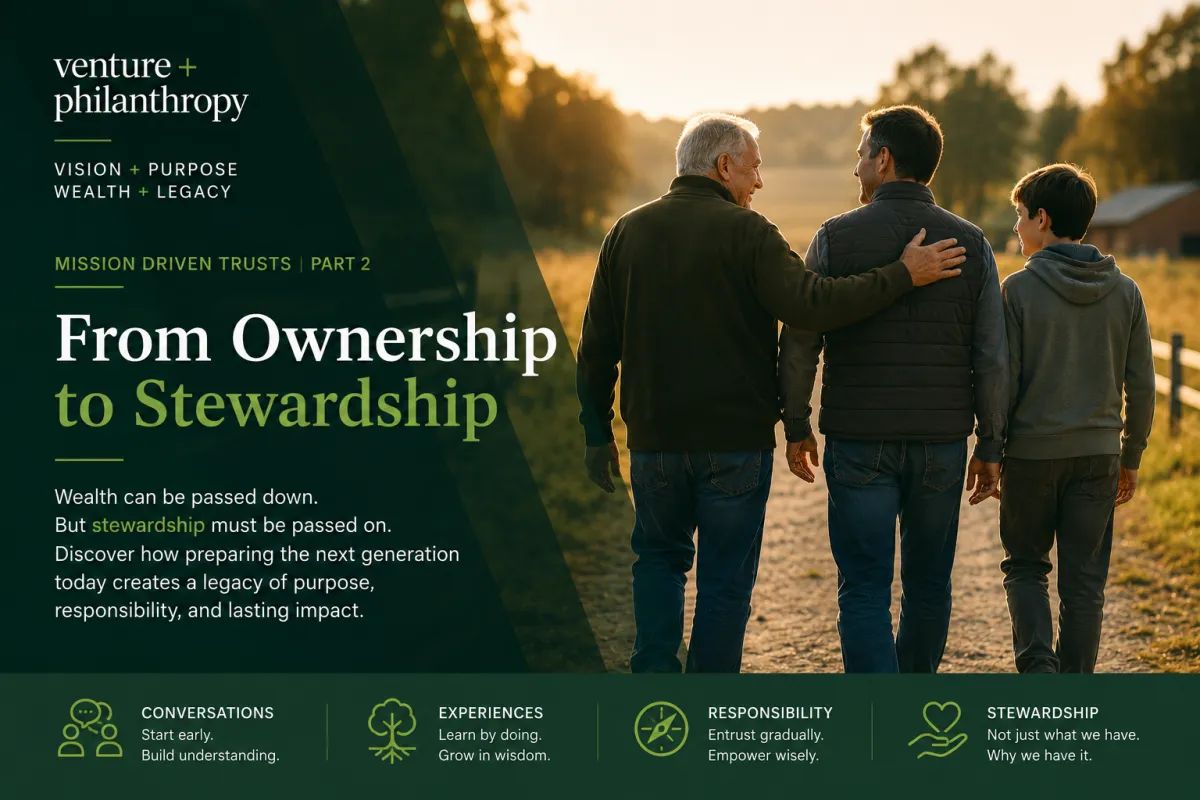
Mission Driven Trusts From Ownership to Stewardship
Imagine a founder sitting across the table from the next generation.
For decades, the business demanded sacrifice.
There were uncertain years, personal guarantees, difficult decisions, missed weekends, and relationships built one customer at a time. Eventually, what began as an idea became a successful enterprise—and something valuable enough to pass on.
The founder looks across the table and realizes:
One day, they may own it. But will they know how to steward it?
That distinction can reshape how a family thinks about legacy.
Ownership Is Not Stewardship
Ownership asks:
What belongs to me?
Stewardship asks:
What has been entrusted to me, and what am I responsible to do with it?
The first generation remembers what it cost to build the business.
The second generation may inherit the results without experiencing the risks and sacrifices that produced them. By the third generation, the founder's experiences can become stories rather than memories.
Assets can transfer instantly.
A stewardship mindset cannot.
It must be cultivated.
The Inheritance Before the Inheritance
Imagine two heirs receiving the same inheritance.
One learns about the family's wealth primarily when it arrives.
The other has spent years hearing the stories behind it.
She knows about the year the business nearly failed. She understands why her grandfather walked away from a profitable opportunity because it violated his principles. She has participated in conversations about investment, generosity, responsibility, and purpose.
Before substantial wealth is ever entrusted to her, she has been given smaller opportunities to make decisions and experience their consequences.
One receives an inheritance.
The other has been prepared for one.
That is the difference stewardship can make.
Preparing Stewards, Not Just Beneficiaries
Legacy planning should therefore begin long before assets change hands.
Families can start by asking:
What responsibilities accompany our resources?
What principles guide our decisions?
What does responsible ownership look like?
How should generosity shape our wealth?
What does our family believe the business exists to accomplish?
These conversations turn inheritance from an event into a process of preparation.
A Mission Driven Trust can reinforce that process by connecting financial resources to a family's philosophy of stewardship.
But a trust document cannot do the work alone.
A document cannot mentor a future leader, tell the founder's stories around the dinner table, teach judgment through experience, or demonstrate generosity.
A trust can provide structure. People develop stewards.
That development happens through conversation, mentoring, governance, increasing responsibility, and meaningful opportunities to participate.
The Greater Inheritance
Perhaps the greatest thing a founder can transfer isn't the company, real estate, investment portfolio, or financial security.
Perhaps it is the wisdom to understand what those resources are for.
Inherited wealth without preparation can become a burden.
But resources entrusted to prepared, purposeful stewards can become a platform for entrepreneurship, generosity, service, and impact for generations.
So don't wait for the estate plan to begin transferring the legacy.
Tell the stories. Share the lessons. Invite participation. Entrust responsibility.
And change the question from: “What will they inherit?” to: “Who are we preparing them to become?”
That may be the most important inheritance of all.
This article discusses general concepts related to family legacy, stewardship, and trust planning and is not legal, tax, investment, or financial advice.
