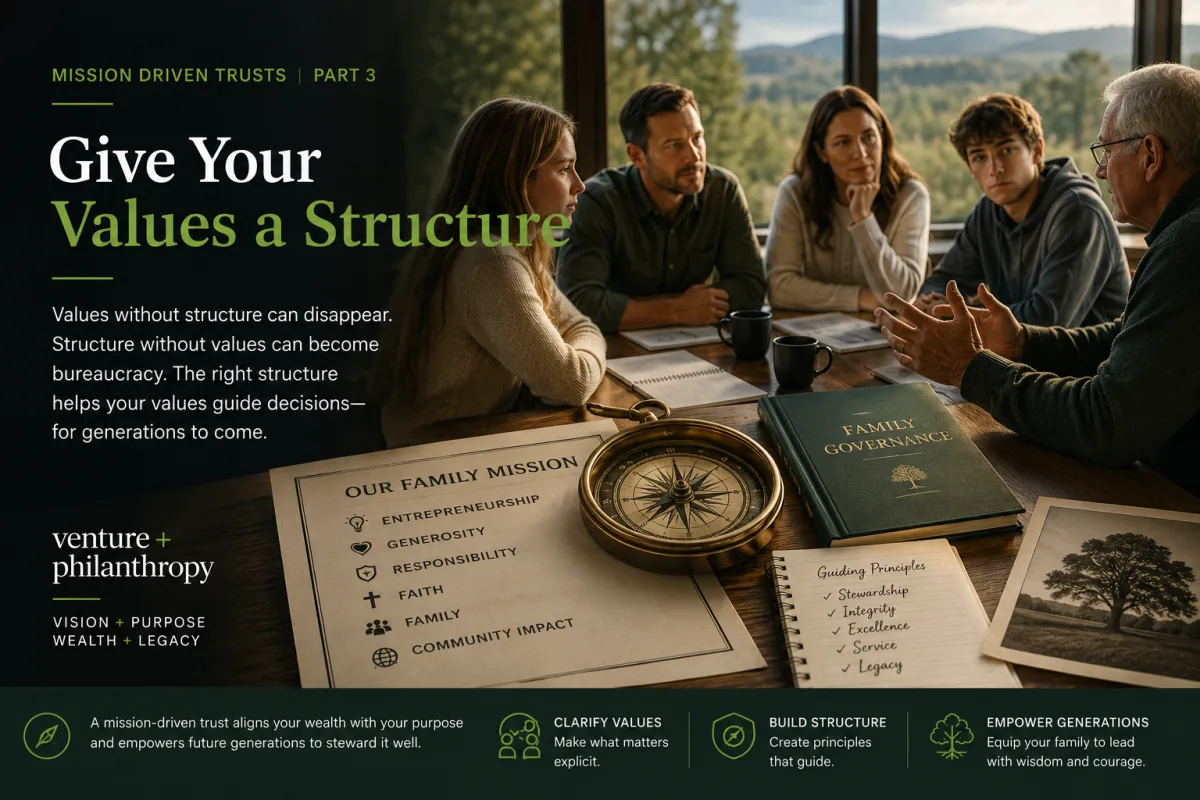
Mission Driven Trusts - Give Your Values a Structure
Imagine a family sitting around a conference table 30 years from now.
The founder is gone.
The company that created the family's wealth has changed significantly. Some assets have been sold. New investments have been made. Children have become parents, grandchildren are now involved, and the economic landscape looks nothing like it did when the business began.
Now the family faces a consequential decision.
The founder would have known what to do.
But the founder isn't in the room.
So someone asks:
“What would Grandpa have wanted?”
There is a long silence.
Everyone remembers pieces of the story.
They remember that he believed in hard work. They remember hearing him talk about generosity. They know family mattered deeply to him. They remember that his word was his bond and that he believed the business existed for something more than making money.
But no one is quite sure how those convictions should shape the decision sitting in front of them.
This is one of the great challenges of legacy.
Values can be deeply held by one generation and only vaguely remembered by the next.
A family might value entrepreneurship, generosity, education, responsibility, service, faith, or community impact.
But unless those values become part of how the family communicates, governs, gives, invests, and makes decisions, they can gradually become little more than stories about the founder.
This is where a Mission Driven Trust can become part of something larger.
The goal isn't to create a legal document filled with instructions designed to control every decision future generations will make.
In fact, trying to anticipate every future circumstance may create the opposite of what the founder intended.
The world will change.
The business will change.
The family will change.
So instead of trying to give future generations every answer, perhaps we should give them something more enduring:
a compass.
A map tells you which road to take based on terrain that already exists.
A compass gives you direction when the terrain changes.
That distinction matters.
A family's mission, values, and philosophy of stewardship can become that compass.
Those principles can then help inform the structures surrounding the family's wealth—trust provisions, governance, family meetings, charitable strategies, investment philosophies, succession planning, letters expressing intent, and opportunities for the next generation to grow in responsibility.
The structure isn't the legacy.
The structure helps carry the legacy.
Now return to that conference table 30 years from today.
The family still faces a decision the founder never anticipated.
But this time, they don't have to ask only:
“What would Grandpa have done?”
They can ask:
“What do we believe, what are these resources for, and what decision best reflects the mission we've been entrusted to carry forward?”
They may not make exactly the decision the founder would have made.
That's not necessarily failure.
Perhaps success is that they have learned to apply enduring principles to circumstances the founder could never have imagined.
Because lasting legacy isn't about controlling every turn future generations take.
It's about giving them a compass strong enough to find their way.
Mission Driven Trusts | Give Your Values a Structure
venture + philanthropy
Vision + Purpose. Wealth + Legacy.
Trust design can involve significant legal, tax, investment, and financial considerations. This article discusses general concepts only. Families should work with qualified professional advisors when developing trust, estate, and legacy strategies.
